Make It Personal… Don’t Take it Personal!
There’s a phrase I come back to often when I talk about customer service:
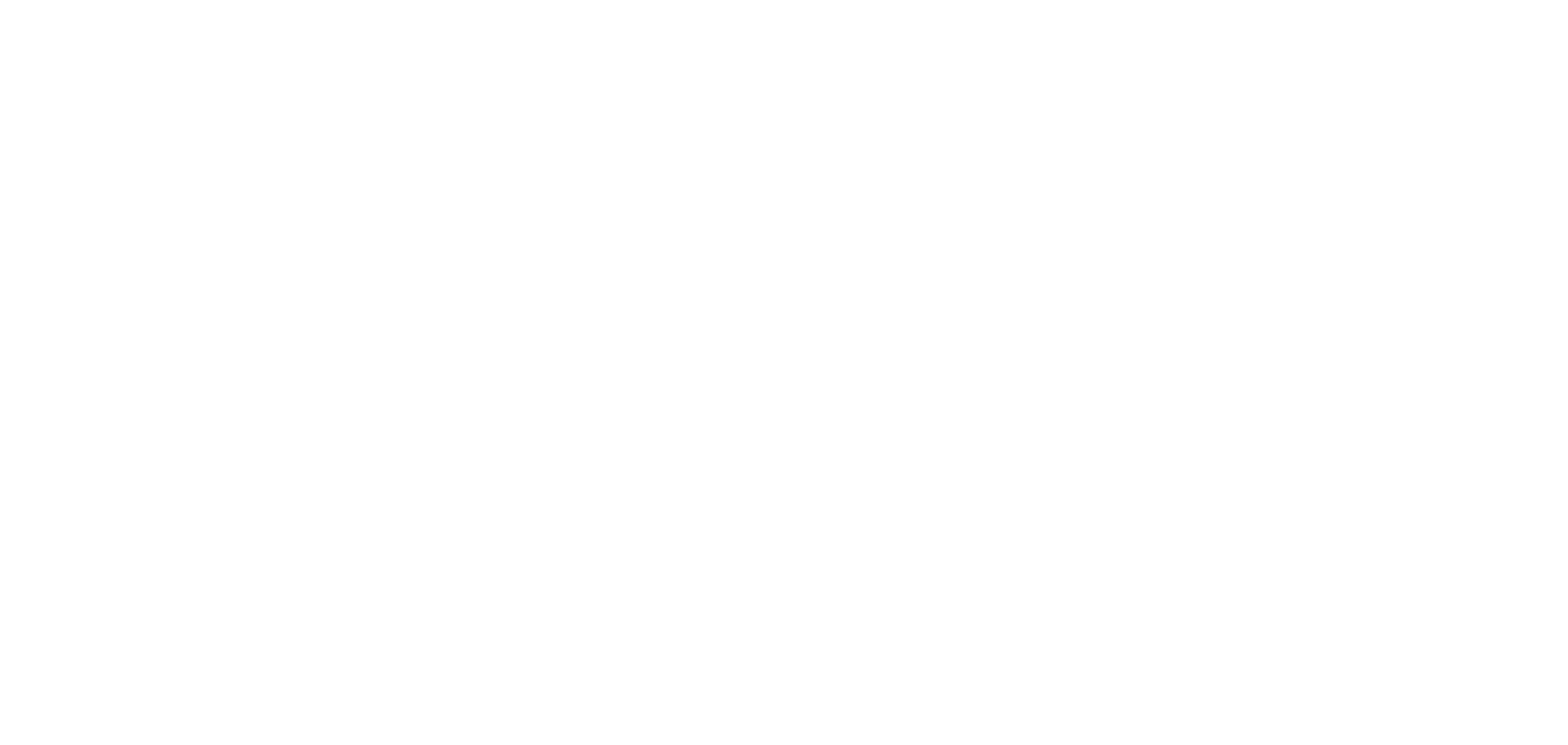
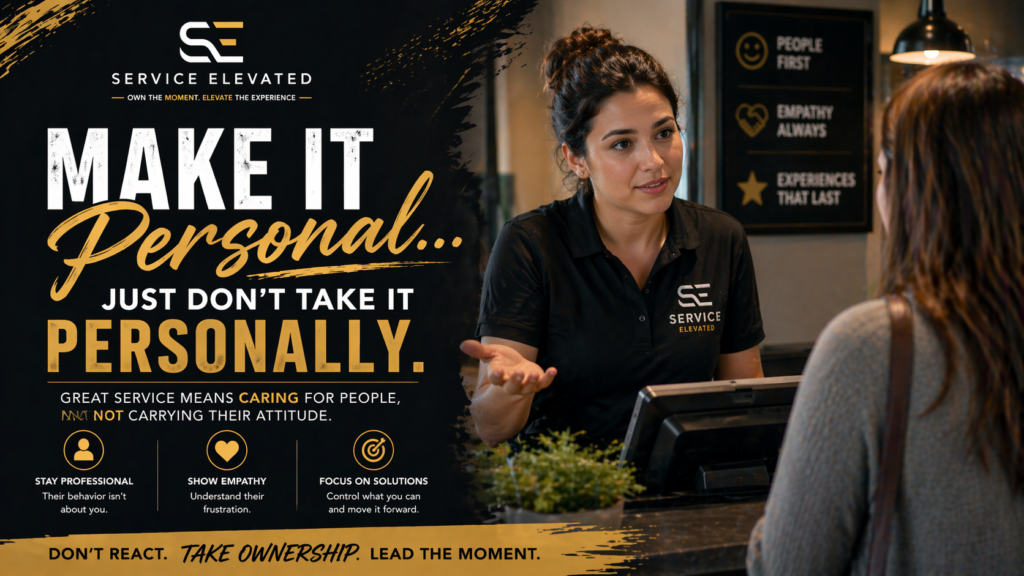
Make it personal. Just don’t take it personally.
It sounds simple, but understanding the difference can completely change how you show up—and how effective you are—in every customer interaction.
Customer service, at its core, is not about transactions. It’s about people. The businesses that win today are the ones that understand that customers are paying for an experience just as much as they are for a product or service. And experience is built in the small moments—how you greet someone, how well you listen, and how clearly you show that you care.
That’s what making it personal looks like.
It’s using someone’s name.
It’s being present in the conversation.
It’s treating their situation like it matters—because to them, it does.
When you do that well, something shifts. The interaction stops feeling transactional and starts feeling human. That’s where loyalty is built. That’s where reviews come from. That’s where repeat business happens.
But this is also where things can go wrong.
Anyone who has worked with customers knows that not every interaction is smooth. People come in frustrated. They’re short, impatient, or sometimes just having a bad day. And if you’re not careful, it’s easy to internalize that.
You start thinking, “Why are they talking to me like that?” or “I didn’t do anything wrong.” The focus shifts from solving the problem to reacting to the person. And the moment that happens, you lose control of the interaction.
The truth is, most of the time, it’s not about you.
Customers bring their frustrations with them—missed expectations, wasted time, prior experiences that didn’t go well. By the time they get to you, you’re simply the person standing in front of them. If you take that personally, you lose your ability to lead the moment.
Great service requires a different mindset.
Instead of reacting to tone or attitude, the focus has to stay on progress. The question is not, “How do I respond to how they’re acting?” It’s, “What’s the actual problem, and how do I move it forward?”
That shift changes everything.
It allows you to stay calm.
It keeps the interaction productive.
And it positions you as someone who is in control, not someone who is reacting.
In practical terms, this can be as simple as pausing and redirecting the conversation. A statement like, “Let’s get this taken care of,” or “Here’s what we can do right now,” moves the focus away from emotion and back to solution.
This is what ownership looks like.
Ownership does not mean taking blame. It does not mean agreeing with everything a customer says. It means taking responsibility for what happens next. It means stepping into the moment and choosing to move it forward, regardless of how it started.
When you do that consistently, you begin to notice a pattern. Tension decreases. Conversations become easier. Customers respond differently. Not because they changed—but because you did.
The best people in customer service understand this balance. They know how to make every interaction feel personal without ever making it about themselves. They stay engaged, present, and focused, but they don’t allow emotions to pull them off course.
That’s the difference between reacting and leading.
And in customer service, the person who leads the moment is the one who defines the outcome.
Welcome… or “How Many?”
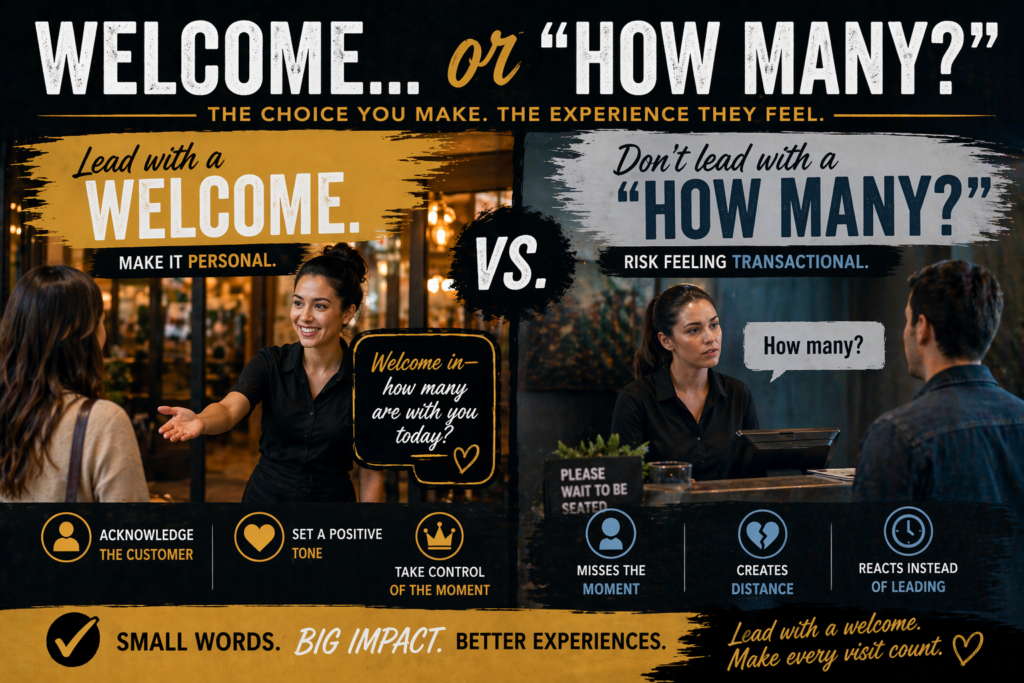
Walk into most restaurants or service businesses and you’ll hear the same opening line: “How many?” It’s quick, efficient, and to the point. It also happens to be one of the easiest ways to make a customer feel like a number instead of a person.
Now compare that to a simple shift: “Welcome in—how many are with you today?” The question is still asked, the information is still gathered, but the experience feels completely different. One approach starts with a transaction. The other starts with a connection.
That first moment matters more than most people realize.
Before any product is delivered or service is provided, the customer is already forming an opinion. They’re deciding whether they feel valued, whether the environment feels inviting, and whether this is going to be a place they enjoy being. The opening interaction sets the tone for all of it.
When the first thing a customer hears is “How many?”, the experience immediately feels transactional. It feels rushed, impersonal, and focused on process. There’s no acknowledgment, no warmth, no sense that the customer actually matters. It’s not offensive, but it’s forgettable—and in customer service, forgettable is a problem.
On the other hand, when a customer is welcomed first, even with something as simple as “Welcome in,” the entire interaction shifts. There’s an instant sense of acknowledgment. The customer feels seen. The experience feels intentional. And from that point forward, everything becomes easier.
Most of the time, this isn’t a training issue as much as it is a habit. Employees are often focused on efficiency—moving the line, gathering information, keeping things flowing. In that mindset, the greeting feels like an extra step instead of a foundational one. So it gets skipped.
But customers are not just there for efficiency. They are paying for the experience just as much as the product. And the experience begins the moment they walk through the door.
Skipping the welcome may seem like a small detail, but small details compound. Over time, they shape how customers feel about a business. They influence whether someone returns, what they say in a review, and how they describe the experience to others. A cold start creates friction. A warm start creates momentum.
The solution is simple and immediate: lead with a welcome.
It doesn’t require a script or a major change in process. It’s a subtle adjustment in how the interaction begins. “Welcome in—how many today?” or “Good evening, welcome—how many are with you?” adds no real time, but it dramatically changes the tone. The customer is acknowledged first, then the need is addressed.
That shift accomplishes more than it seems. It creates a sense of value, sets a positive expectation, and positions the employee as someone who is leading the interaction rather than just processing it. It is a small act of ownership that sets everything else up to go right.
Customers may not remember every detail of their visit, but they will remember how it felt. And that feeling is often decided in the first few seconds.
In customer service, the smallest changes often create the biggest impact. Leading with a welcome instead of a number is one of those changes.
You Don’t Get a Second First Impression
First impressions are not a small thing in customer service—they’re the thing.
Before a word is spoken, before a product is discussed, before any value is proven, the customer has already started forming an opinion. And whether we like it or not, that opinion sets the tone for everything that follows.
The reality is simple: people decide how they feel about a business almost immediately. Sometimes it’s the greeting. Sometimes it’s the body language. Sometimes it’s the lack of acknowledgment altogether. But in those first few seconds, a decision is being made:
Do I feel welcome here, or not?
That decision matters more than most people realize.
What a First Impression Actually Does
A strong first impression doesn’t just make someone feel good—it creates momentum.
When a customer feels acknowledged and valued right away:
- They’re more patient
- They’re more understanding
- They’re more open to solutions
You’ve made the rest of the interaction easier before it even begins.
But when that first moment is missed—when there’s no eye contact, no greeting, no energy—you’re already behind. Now the customer isn’t just there for a product or service. They’re questioning the experience.
And once that doubt creeps in, everything feels harder.
The Silent Signals
First impressions are not built on what you say—they’re built on what you show.
Customers are picking up on things like:
- Your posture
- Your tone
- Your facial expression
- Whether you look engaged or distracted
You can say all the right words, but if your presence doesn’t match, the impression falls flat.
People don’t analyze this consciously. They just feel it.
And that feeling becomes their truth.
The Common Miss
Most service breakdowns at the start aren’t intentional. They happen because people are busy, distracted, or focused on tasks instead of people.
You’ve seen it:
- Someone walks in and isn’t acknowledged
- An employee finishes what they’re doing before even looking up
- The greeting feels rushed or forced
No one is trying to create a bad experience—but that’s exactly what happens.
Because to the customer, it doesn’t feel like you’re busy.
It feels like they don’t matter.
The Tactical Shift (Use This Immediately)
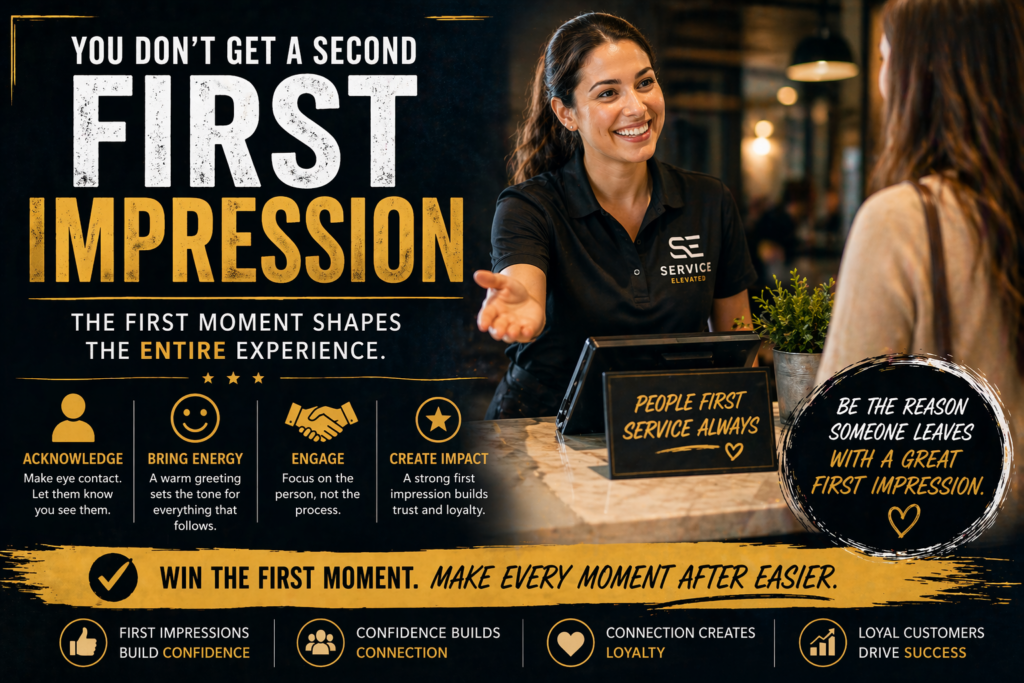
If you want to improve first impressions, don’t overcomplicate it. Focus on three simple actions:
1. Acknowledge immediately
Even if you can’t help right away, make eye contact and let them know you see them. A quick “I’ll be right with you” goes a long way.
2. Bring energy to the greeting
Not fake enthusiasm—just presence. A genuine, confident “Good morning” or “How can I help you?” sets the tone.
3. Engage, don’t process
Don’t treat the interaction like a task to complete. Treat it like a person to connect with.
That’s it.
These aren’t advanced techniques. They’re fundamentals. But when done consistently, they separate average service from great service.
Why This Matters More Than You Think
Customers don’t just judge a single moment—they use that moment to predict the entire experience.
A strong first impression tells them:
- This place is organized
- These people care
- I’m in good hands
A weak one tells them the opposite.
And once that perception is set, everything you do after has to either reinforce it or fight against it.
Final Thought
You don’t get a second first impression.
You get one opportunity to set the tone, build trust, and create momentum. And it happens faster than most people think.
The best in service don’t leave that moment to chance. They own it.
Because they understand something simple:
If you win the first moment,
you make every moment after easier.
The Hidden Revenue Driver: Why Customer Service Is No Longer Optional
By Service Elevated
The Problem Most Businesses Don’t See
Most organizations spend thousands of dollars attracting new customers. They invest in marketing, advertising, websites, social media, equipment, and facilities.
Yet many overlook the one factor that determines whether customers return:
The experience they have with your people.
Research consistently shows that customers are willing to leave a business after just one poor service experience. In today’s digital world, that experience doesn’t end with a lost customer—it often results in a negative review, reduced referrals, and damage to the brand’s reputation.
The reality is simple:
Customers remember how they were treated long after they forget what they purchased.
The Cost of Poor Customer Service
Poor customer service impacts businesses in four critical ways:
1. Lost Revenue
Acquiring a new customer can cost significantly more than retaining an existing one. When customers leave because of poor service, businesses must spend additional resources replacing them.
2. Negative Reviews
Online reviews have become the modern word-of-mouth referral system. One poor interaction can influence hundreds of future buying decisions.
3. Employee Disengagement
Customer service challenges often stem from employees feeling disconnected, unempowered, or uncertain about expectations.
4. Damaged Reputation
Customers share both positive and negative experiences. Businesses that consistently deliver exceptional service create loyal advocates who promote the brand without being asked.
What Great Customer Service Actually Looks Like
Exceptional customer service is not about scripted responses or forced friendliness.
It is about ownership.
Employees who take ownership:
Solve problems instead of passing them on.
Look for solutions rather than excuses.
Take responsibility for outcomes.
Create positive customer experiences without waiting for permission.
When ownership becomes part of a company’s culture, service improves naturally.
The Business Impact of Ownership
Organizations that empower employees to take ownership often experience:
Increased customer retention
Higher customer satisfaction
More positive online reviews
Stronger employee engagement
Increased revenue through repeat business
Greater customer loyalty
The businesses that consistently outperform competitors are rarely the cheapest or the most convenient.
They are the easiest to do business with.
Why Traditional Customer Service Training Falls Short
Many training programs focus on policies, procedures, and scripts.
Employees leave knowing what to say but not why it matters.
The result is temporary improvement followed by a return to old habits.
Real change occurs when employees understand:
How their actions impact the customer experience
How service affects company growth
How ownership creates better outcomes for customers and employees alike
The Service Elevated Approach
Service Elevated was built on a simple belief:
Service trumps quality. Service trumps price. Service creates loyalty.
Our ownership-based training helps employees understand that every interaction affects retention, reviews, referrals, and revenue.
The program focuses on:
Personal ownership
Employee empowerment
Customer experience
Problem-solving
Accountability
Creating lasting customer loyalty
Rather than teaching employees what to think, we teach them how to take ownership of every customer interaction.
The Bottom Line
Products can be copied.
Prices can be matched.
Facilities can be replicated.
Customer service remains one of the few competitive advantages that competitors cannot easily duplicate.
Businesses that prioritize ownership and service create loyal customers, stronger teams, and sustainable growth.
At Service Elevated, we help organizations build that advantage.
Learn More
Service Elevated
serviceelevated.com
Because great service isn’t an accident—it’s a culture.